 Alton Climate Action Network
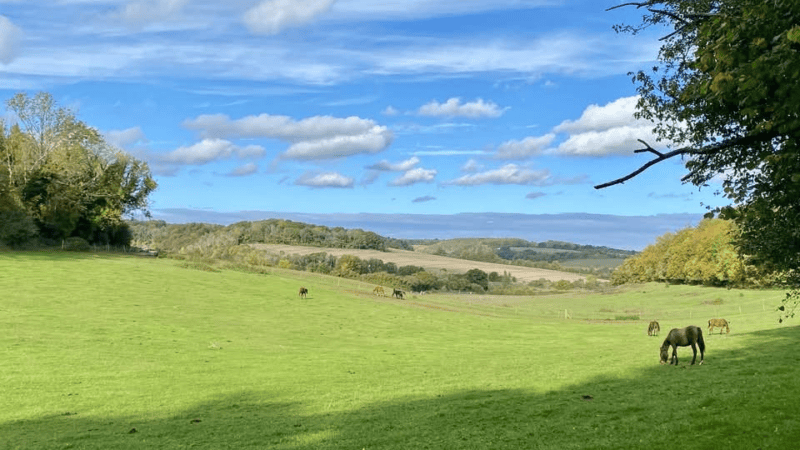
View towards Alton from Beech (photo by Ginny Boxall)
New housing is inevitable but must minimise its impact on the environment, including nature and landscape, water, transport, and of course energy efficiency. For these reasons, ACAN is actively supporting The Alton Society’s work on large-scale planning proposals for new housing.
Ginny Boxall, East Hants District and Alton Town Councillor and a member of The Alton Society, delivered the following speech at The Alton Society’s AGM on 14 November. It is concerned about Planning and Growth, emphasizing pragmatic engagement and collaborative advocacy to protect the town’s character while accommodating necessary growth.
Cllr Ginny Boxall

As a member of the Alton Society, I know we share a deep affection for our town. We want to see Alton thrive, but without losing the character, heritage, landscape and sense of community that make it special. As a local ward councillor, I also hear at first hand the concerns residents have about development, traffic, infrastructure and the future of our town. I understand the frustration people feel when they believe decisions affecting their neighbourhood are being made without sufficient local input.
Today, I want to talk about three things: where we are with East Hampshire District Council’s Local Plan, what the changing planning system means for Alton, and what we, as the Alton Society, can realistically do to make our voices heard.
Where are we with the Local Plan?
East Hampshire’s planning policy has been through a period of considerable uncertainty. Changes to national planning policy, increased pressure to deliver housing and uncertainty over local government reorganisation have all affected the Council’s approach. EHDC is preparing to move forward with a new Local Plan, drawing on evidence and consultation work already undertaken. There are also proposals for a supplementary plan, with a particular emphasis on the quality and design of development. For Alton, this matters enormously.
The Local plan will go out for consultation from 7th Dec. The Local Plan should do much more than identify how many houses we need. It should help determine where development takes place, how it relates to the existing town, what infrastructure is required and how we protect the things that make Alton distinctive. We need to consider our historic centre, important views, surrounding countryside, green spaces, roads and public transport, schools, healthcare, drainage and water supplies. These are not optional extras. They are fundamental to creating a town that works for the people who live here.
But we must also recognise the pressures on the planning system. National housing requirements place significant demands on local authorities, and there are limits to what a district council can achieve when national policy is pushing for more homes. Our task is to make sure that, within those constraints, Alton’s needs and character are properly understood and taken seriously.
What has changed in the planning system?
This is perhaps the most important issue for us today. The planning system is changing significantly, with a clear national emphasis on increasing housing delivery and speeding up decisions. One consequence is that the opportunities for elected councillors to influence individual planning decisions are becoming more restricted. Traditionally, residents might raise concerns with their ward councillor, who could seek to have a contentious application considered by the Planning Committee. This gave residents an opportunity to see their concerns debated publicly by elected representatives.
However, the new national scheme of delegation, which took effect on 31 October 2026, changes how applications are allocated between planning officers and committees. Many applications will be decided by officers, and the ability to refer contentious applications to committee will be more limited. For smaller developments, including many sites of fewer than 100 homes, there may be little prospect of a committee hearing. The precise arrangements depend on the type of application and the applicable delegation criteria. This is a significant change for local democracy. Even where residents feel strongly about a proposal, there may be no opportunity for elected councillors to debate it at a public planning meeting.
We need to be realistic about what this means. A petition signed by hundreds of residents does not automatically stop a development. Nor does a ward councillor’s opposition guarantee that an application will be considered by the Planning Committee. Planning officers must assess applications against national policy, the development plan and other relevant planning considerations. Decisions must be based on proper planning grounds, rather than simply whether a proposal is popular. As councillors, we must continue to listen, scrutinise proposals, raise legitimate planning concerns and press for the right evidence. But we cannot promise residents that we can secure a committee hearing or prevent a development through individual intervention.
So where does that leave us? I believe it makes the work of the Alton Society more important than ever. If we have fewer opportunities to influence individual decisions at committee, we must concentrate on influencing the policies, standards and evidence that shape those decisions in the first place.
How can we make our voices heard?
I see five practical ways in which the Alton Society can make a real difference.
First, influence the Local Plan and supplementary plan. This is where we have a genuine opportunity to shape the future of Alton. We need to engage with EHDC while policies are being developed, rather than waiting until planning applications arrive. The Local Plan should establish an appropriate strategy for growth, supported by evidence about the town’s capacity, infrastructure and environmental constraints.
The proposed supplementary plan offers another important opportunity. Its focus on design, layout, landscaping, green infrastructure, movement and climate resilience could help establish clearer expectations for new development. The Society should seek policies that are specific, locally relevant and capable of being applied when applications are assessed. What should good development look like at the edge of Alton? How should new streets connect with existing neighbourhoods? What standards should apply to landscaping, biodiversity, walking and cycling? How can development respect the scale and character of its surroundings?
We should not simply say that we want better development. We should explain what better development means and provide evidence to support it. We should also remember that a supplementary plan focused on design will not, on its own, determine where all future housing goes. That broader question belongs primarily to the Local Plan.
Secondly, build a strong evidence base for Alton. Local knowledge is one of the Society’s greatest assets, but we need to turn that knowledge into something the planning system can use. We could develop a well-organised record of the town’s important historic buildings, views, landscapes, green spaces, walking routes and areas of particular character. We could document traffic congestion, pedestrian safety concerns, drainage problems and pressures on local facilities, working with the relevant organisations to establish the facts. Photographs, maps, surveys and properly documented examples are far more persuasive than general expressions of concern.
Where possible, we should work with technical specialists and relevant organisations to ensure our evidence is accurate and robust. This work would give us a resource that could be used repeatedly: in Local Plan consultations, in discussions with developers and, where relevant, in representations on individual planning applications.
Thirdly, be more strategic about individual planning applications. Although the opportunities to refer applications to committee are being reduced, public participation has not disappeared. Residents, the Society and the Town Council can still submit representations on planning applications. Planning authorities must take relevant representations into account, although objections do not automatically mean that permission will be refused. The important question is how we make those representations count.
A long list of objections repeating the same general concerns may carry less practical weight than a carefully prepared submission identifying specific planning problems and explaining why they matter. We should focus on issues such as conflicts with development plan policies, harm to heritage assets, highway safety, inadequate drainage, ecological impacts, poor design and the failure to provide necessary infrastructure. We should also be alert to applications where important information is missing or where the relationship between a proposed development and the wider town has not been properly considered.
The Society could help residents understand how to respond effectively, identify the strongest planning arguments and coordinate evidence so that important issues are not overlooked. We should engage early with developers where appropriate, too. Once a scheme has been designed and an application submitted, changing its fundamental layout or approach can be difficult. Early discussion may provide a better opportunity to influence the outcome. We cannot guarantee that our concerns will prevail, but we can make sure they are properly expressed, supported and considered.
Fourthly, champion genuinely sustainable development. We should not treat sustainability as a collection of fashionable words in a planning document. It needs to translate into practical improvements for people living in Alton. Good design should include energy efficiency, effective insulation, appropriate renewable energy, sustainable drainage, green spaces and biodiversity.
Water deserves particular attention. Water resources are an important consideration in our area, and new housing should be designed to use water efficiently. That means encouraging water-efficient fittings and appliances, dual-flush toilets and, where practical and appropriate, rainwater harvesting and water reuse. These measures should be considered from the outset, alongside the wider question of whether water supplies and wastewater infrastructure can support the proposed development.
We should also look beyond individual homes. Can new neighbourhoods support walking and cycling? Can green spaces help manage surface water and provide habitats? Can the layout reduce unnecessary car journeys and connect people to existing facilities? The Society can help establish what good practice looks like and argue for it consistently through the planning process. We should, however, distinguish between what we would like to see and what planning policy can actually require. Our proposals need to be supported by appropriate evidence and framed in a way that can be applied in practice.
Fifthly, work together and make the Society a constructive voice for Alton. The Alton Society should not have to do this alone. We have the Town Council, ward councillors, residents, ACAN, Cycle Alton and many others who share an interest in the future of our town. Each brings a different perspective and different expertise. Together, we could develop a shared vision for Alton that identifies the places we want to protect, the improvements we want to achieve, the infrastructure we need and the standards we expect from new development. We could agree a small number of clear priorities, gather evidence to support them and communicate them consistently to EHDC.
We should also maintain a dialogue with planning policy officers, attend relevant meetings, respond to consultations and ask clear questions about how local concerns are being addressed. And we should hold the Council to account for the quality of its plans, the evidence supporting its decisions and the delivery of infrastructure alongside housing. This is not about opposing every development. Nor is it about pretending that we can prevent change. It is about being a credible, informed and persistent voice for Alton.
What should our priorities be? If I were to suggest a starting point, I would ask the Society to concentrate on three things.
First, define what makes Alton special and identify the aspects of its character, heritage and landscape that future development must respect.
Secondly, establish the infrastructure and environmental issues that must be addressed if the town is to accommodate growth successfully, including transport, drainage, healthcare, schools and water resources.
Thirdly, develop a clear set of design and sustainability principles that we can promote through the Local Plan, the proposed supplementary plan and individual planning applications.
These priorities would give the Society a practical programme of work, rather than leaving us to respond to each new proposal as it appears. They would also allow us to work constructively with the Council and developers while remaining independent and prepared to challenge proposals when necessary.
Looking ahead Let me finish with this thought. Alton will change. There is little point in pretending otherwise. National planning policy is placing substantial pressure on local authorities to deliver housing, and the opportunities for local councillors to intervene in individual planning decisions are becoming more restricted. We need to be honest about that reality.
But it does not mean that our voice no longer matters. It means we must use it differently. We need to be organised, evidence-based and involved early. We need to understand how the planning system works, make our case in the places where it can have the greatest effect, and work together rather than in isolation. As members of the Alton Society, we have a valuable understanding of our town and what makes it distinctive. We can use that knowledge to champion development that respects Alton’s heritage, provides the infrastructure people need, protects our environment and makes responsible use of energy and water.
We may not be able to determine every planning decision, and we should not promise that we can. But we can help shape the policies against which those decisions are made. We can ensure that local evidence is available, that important issues are raised and that the case for a better future for Alton is made clearly and consistently. Our challenge is not simply to resist the changes coming to Alton. It is to make sure that, as our town grows, its voice is heard, its character is respected and its future is planned as well as possible.
Landscape photo credits: Ginny Boxall